Do you remember your first day at DANREC?
– Yes, I actually remember it quite well. We started on the Monday up by the machines. I was working with a guy called Ivan, but I was a bit on my own at first, trying to figure out what I was supposed to do. So it was quite a start.
How did you end up at DANREC?
– I had been unemployed for a while and had reached the point where I needed to get back to work. Then I saw a temporary position here and thought it might be something for me. To begin with, it was simply an open-ended temporary position. And now ten years have passed.
What is the biggest difference between DANREC then and now?
– A lot has changed. Especially when it comes to IT and electronics. Back then, things were much more old-fashioned. We practically only had two computers, and they were in the office. Apart from that, it was whiteboards, paper and pencil.
Today, much more is done electronically. We also have far more customers, but at the same time we have better systems to keep track of everything.
You haven’t worked in the warehouse for all ten years?
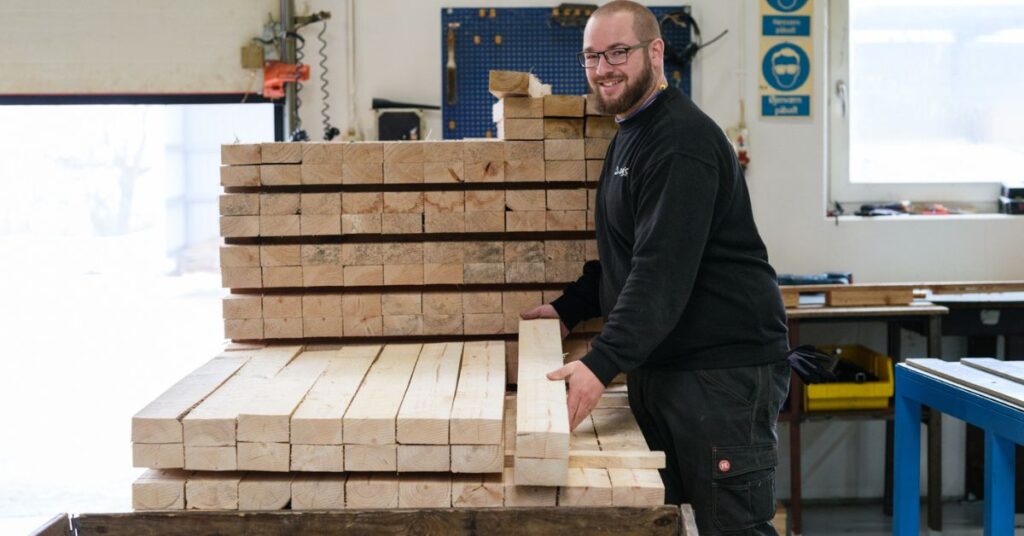
– No, I started in production. I’ve worked in different areas over the years, including 12-hour shifts. Eventually, I moved to the warehouse, which was something I had wanted for quite a while. So this is where I’m staying.
Here, I work from seven to three, and that suits me well. When I was working 12-hour shifts, there could be several days when I hardly saw my children. By the time I got home, they were already in bed. So working hours obviously make a difference.
What has made you stay for ten years?
– The freedom. There isn’t someone constantly telling you, “Now you need to do this, and now you need to do that.”
You can plan your own day and make things work. There isn’t someone constantly looking over your shoulder. That is definitely one of the best things about the job.
I’ve always had jobs where I’ve worked very independently. I’m perfectly capable of thinking for myself.
What does ten years of experience mean in practice?
– A lot. There are many things you simply have to see and experience in practice. The materials vary, and the machines react differently. Over time, you develop a feel for it.
Once you’ve been here long enough, you also get to know the machines by their sound. Sometimes you can be sitting on a break and suddenly think, “Something doesn’t sound right.” You simply know what things are supposed to sound like.
When you’re new and see a large control panel with maybe 500 buttons, it can look incredibly overwhelming. But in reality, there may only be three or four buttons you actually use when the machine is running. You learn that gradually.
How important are your colleagues?
– Very important. Especially when you work long shifts, you work extremely closely together. You almost spend more time with your colleagues than you do at home.
It’s difficult to single out one particular person. Everyone I’ve worked with over the years has had an impact on what it has been like to work here. Good colleagues are an important part of it.
Is there anything from the past ten years that you remember particularly well?
– A lot has happened, of course. But I remember one time when Martin reversed a forklift onto the lawn. He didn’t quite manage to stop it, and the whole forklift ended up out on the grass. So we had to get another forklift to pull him out.
It was pretty funny – probably mostly because it wasn’t me!
If you could go back and give yourself one piece of advice on your first day, what would it be?
– The same thing I tell new employees today: Spend the first couple of days walking around and looking. Find out where things are and how everything works.
It can seem very overwhelming at first, especially in production with all the machines and buttons. But you quickly figure out what you actually need to use.
The rest comes with experience.